

Sportsland SUGO Celebrates 50 Years
A Japanese hillside packed with speed
Tucked into the rolling foothills of the Zao mountain range in Murata, just 25km from the vibrant city of Sendai, you’ll find the undulating and picturesque Sportsland SUGO circuit. Owned by Yamaha Motor Company, the venue opened in 1975 and this year celebrates its 50th birthday.

From the outset, the brief was clear: build a multi-discipline motorsport park that tests riders, drivers and machines. Half a century on, the complex has earned a reputation for producing exciting racing action, having hosted Japan’s top series on two- and four-wheeled machines. It has also welcomed a host of global stars along the way.

What sets Sportsland SUGO apart from other circuits in Japan is the wide range of competition it can host. The complex features an international road racing course, an international motocross course, and the CIK/FIA-certified International West Course for go-karts, gymkhana, and supermoto, as well as a trials area and training fields. It’s the only venue in Japan with three internationally certified courses that can run events simultaneously.
 The International Racing Course is the centrepiece of SUGO: a 3.621km ribbon (3.586km without chicanes) whose 70m of elevation change and blind crests demand bravery every lap. There’s a 704m back straight, 10–12.5m of track width, and a main straight that climbs for 600m at a punishing 10 per cent gradient. The surrounding hillsides dictate the circuit’s rhythm with plunging descents that lead to technical sequences and a full-commit charge to the line.

Through the 1980s and 1990s, SUGO evolved from Yamaha’s proving ground into a fixture of Japan’s premier championships. Today’s calendar features the All Japan Road Race series, Super Taikyu, Super Formula, Super GT, and Formula Drift Japan, with motocross, trials, and karting also taking centre stage.
Jay Wilson has been based in Japan racing and testing with Yamaha in recent years and won the 2024 All-Japan Motocross Championship.

Jay Wilson – 2024 All-Japan MX Champ on Sugo
“Sugo is Yamaha’s own racetrack in Japan, and being a Yamaha Factory rider myself, it’s always one of my favourite tracks to race at. Sugo is one of the few rounds of the All Japan Motocross Championship open to international riders, so many big names in our sport have raced there. This year, I was lucky enough to share the track with the 2025 World Champion Romain Febvre, and Sugo was actually the first-ever track I raced in Japan, which kick-started the chapter of my career racing and testing with YMC.

“The track itself is very physically demanding, the ruts are deep, and Japanese ruts aren’t long and consistent; they are sharp and aggressive, and you have to be on a bike setup, or it’s challenging to get around. The fans have views from all different areas – the KYB jump, the European section, and Sugo hill are all pretty iconic.

“Finally, the fans at Sugo are special. Because it’s the only round to get international riders, they often are incredibly generous – Last year I was gifted a samurai sword there, and this year we even got a customised Yamaha Factory Racing pooper scooper for our dog – the fans put in a huge effort to show their support to us riders, especially at Sugo.”

Over the years, SUGO has also welcomed World Superbike and Motocross Grand Prix rounds. Legends including Kenny Roberts, Eddie Lawson, Wayne Rainey, Kevin Schwantz, and Michael Doohan have conquered the course on two wheels, while Ayrton Senna and Michael Schumacher have turned fast laps on four.

Mick Doohan took his maiden victory in the All-Japan Superbike Championship at Sugo in 1988 on a Yamaha FZR750 and was called up later that year by the Marlboro Dealer Team to race for them in the World Superbike event at Sugo. A 22-year-old Doohan didn’t fare so well in the first wet race but made a statement in the second bout. Doohan recounted the Sugo World Superbike victory to Cycle News…
Mick Doohan
“I won it, and won it quite easily. Within two weeks, Honda was at my door at home wanting me to sign with them. I won the next race in Australia and then went and tested the Yamaha [GP bike]. Then I signed for Honda when I went to Fuji to do an F1 race. And Yamaha wasn’t too pleased. I signed with Honda on a Saturday and had to race for Yamaha the following day. Everything I did in Japan in 1987 and ’88, I couldn’t put a foot wrong, and that sort of steered me on the path to go Grand Prix racing.”

Daryl Beattie won races in the All Japan 500 cc Road Racing Championships in 1992 and recapped a couple of distinct Sugo memories for us. Daryl has some great memories from Japan that also include a victory at the Suzuka 8 Hours.
Daryl Beattie on Sugo
“I rode once and only once, the V4 twin-crank NSR500 at Sugo in a secret test with the factory. The Yamaha was a twin-crank, but the Honda was always a single-crank. Honda wanted to test a twin-crank engine, and we went to Sugo, where I put about 30 laps on it with the HRC President and a small group of technicians. Then, it disappeared… Sugo was also renowned for having some of the finest rice in Japan. If you managed to get pole position, they gave you a 5 kg bag of rice; the mechanics would be all over me for it, as it was like gold to them.”

Kevin Magee was also highly active in Japan around the same time, with plenty of miles under his belt at Sugo, not to mention back-to-back victories at the Suzuka 8 Hours for the Horsham Hurricane.

Kevin Magee won the 1987 round of the Formula 1 Motorcycle Championship at Sugo on a YZF750 and also claimed podium results in the TBC (Tohuku Broadcasting System) Big Race at the circuit on the YZR500.

Magee has some great stories from Sugo about hot-rodding the Yamaha-supplied golf carts and rolling them, once onto his passenger Warren Willing and another time onto Aaron Slight… Racing the likes of Pirovano, Goddard, Slight and Phillis from Sendai to Sugo in cheap cars. Riding a BW200 up in the hills behind Sugo to warm up his arms properly before races to help stave off arm pump. To grabbing the knee of Aaron Slight to help push himself forward an inch to beat the Kiwi across the line at Sugo…

Sugo also played a pivotal role in shaping the career of Australia’s most successful World Superbike racer. Troy Bayliss had his first-ever ride on the Factory Ducati World Superbike at Sugo when he was called up to replace the injured Carl Fogarty in early 2000. It didn’t exactly go to plan…

Troy Bayliss on Sugo
“My first ever ride on the Ducati World Superbike was there; it was also my first time on Michelin rubber. I received the call to replace Carl Fogarty after he was injured, and I didn’t complete a single lap in either of the races. In the first race, I got caught up in a turn-one pile-up, and in the second race, Tamada took me out. After that, I thought I would never get on that bike again, and at first, it looked as though Ducati were of that opinion. They put Luca Cadalora on it next time out at Donington, which I thought was strange as I was coming from BSB and knew Donington, but anyway, Cadalora didn’t go too well. So they put me on the bike at Monza, a track I didn’t know, but Cadalora did… You would have imagined it would have been the other way around, but nonetheless, I managed to impress them at Monza (Troy made an incredible overtake of five riders in a single corner to take the race lead). As they say, the rest is history…”

Steve Martin rode World Superbikes at Sugo in the early 2000s, but ten years before that, the South Australian also rode a Yoshimura Suzuki GSX-R750 in F1 trim in the All-Japan Championship when he was 21.
Steve Martin on Sugo
“Back then (1990), it was a daunting circuit. Full of walls and blind corners, especially if you weren’t on the right rubber! If you think Laguna Seca has some undulation, Sugo is on a whole new level. I crashed four times in one weekend there. Fuji Yoshimura put his hands on my shoulders and said Steve, if you crash any more, we don’t have any more parts left. I think Yoshimura found every photo of me on that bike and deleted it or erased it from their memory, although Fuji still likes me… I also raced there in World Superbike back in the days when the factory Japanese riders had real Japanese factory bikes, and boy, were they hard to beat. In the end, a good result at Sugo for me was being able to leave the circuit without the Aid of a walking stick!”

Chris Vermulen has some slightly more positive memories of Sugo.
Chris Vermeulen on Sugo
“I remember watching races on TV from Sugo as a kid, my heroes like Slight, Edwards and Corser, but it was the Japanese wildcards that were so special there, Tamada comes to mind. When I went there racing WSS in 2001 for the first time, I realised how technical it was and hard to learn with all of the blind corners, but when you got it right, it was a great track to ride, an old school circuit with real character.”

Adam Fergusson was another Aussie who got to sample Sugo on World Supersport machinery in 2001, and Krusty also got to throw a leg over some other special things while in Japan!
Adam Fergusson on Sugo
“Sugo was one of those circuits that you either really enjoyed or hated. I quite liked the place as the layout really suited my style of flowing between the corners, and a lot less point-and-shoot style. I first cut laps there at the end of 2000 in a two-day test with HRC, and then raced in the World Supersport Championship at that location in 2001, but unfortunately crashed out from a good position. It was a very technical circuit, with a ton of elevation changes that really lent itself to precision riding. The surface could be a bit sketchy at times, and I tended to struggle a bit exiting the final chicane and navigating the long hill to the finish. That was the downside of being slightly bigger than the opposition or just being a fatty, as most would say. Sugo was my first real experience dealing with HRC, as I assisted with the development of the 2001 Honda CBR600 World Supersport bike alongside Spain’s Pere Riba. They were obviously happy with my input, as HRC invited me to Motegi the following week to have a play on a few of their other bikes. The Castrol Honda VTR1000 SP2 that Colin Edwards piloted, the Suzuka 8 Hour bike, Daijiro Kato’s (RIP) NSR250 and the one that will stay in my memory for all eternity, Alex Criville’s title-winning NSR500V4!”

As the machinery advanced, so did the facility. A major resurfacing in 2014 refreshed the road course. The motocross side gained a new main building, with additional grandstands arriving in 2017 and 2018. Access was improved in 2019 with the construction of a new tunnel from Sendai Airport. Recent upgrades continue to refine the complex.
Young Australian Hunter Corney on the grid at Sugo this year in the second round of the 2025 Asia Pacific R3 Cup
Hunter Corney on Sugo
“It was so cool to race at Sugo knowing it was their 50th anniversary. It was a tough weekend, though, because of my first time riding at that track, and it’s a very challenging track with all of the fast sweepers and blind crests. Each Session I found more flow and confidence and riding there. Reminded me exactly why I love this sport and want to keep pushing for bigger opportunities. The track surface was super smooth, riding on the back straight through the trees felt like riding through a forest, as some of those trees were huge after being there a very long time. Everything felt really clean, professional and on another level. My favourite part was coming up to and going under the big Dunlop bridge, as I had ridden under it countless times while playing on my Xbox in the lead-up to the event, and then doing it in real life was pretty surreal. It was easy to see why everyone says Sugo is one of the best tracks in Japan.”

What makes SUGO such a compelling challenge is its topography. A quick lap demands more than outright speed; it requires strategy. The uphill main straight punishes gearing and tyres, while the downhill blast on the back straight flows into consecutive corners that reward teams who have worked out good mechanical grip and aero balance. SUGO is a rider’s and driver’s circuit, where confidence builds slowly and mistakes are costly.

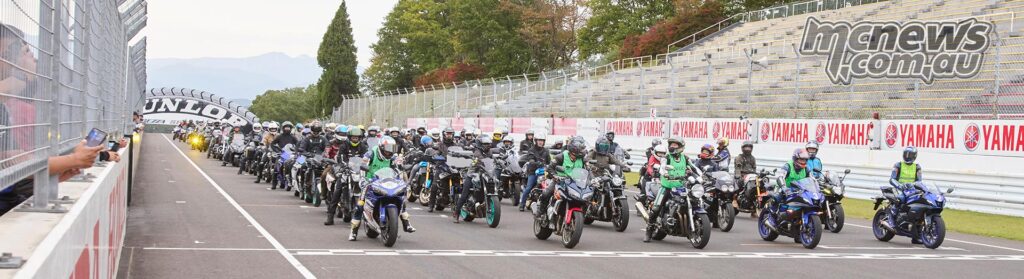
Sugo also hosts events such as this year’s ‘My Yamaha Motorcycle Day‘. An event that MCNews.com.au was lucky enough to attend and enjoy this year.
Today, SUGO remains wholly owned by Yamaha Motor Co., Ltd. and operated by SUGO Co., Ltd., with a clear commitment to the next fifty years: to provide a stage for competition and a laboratory for improvement. The next chapter is already underway, featuring new pits, refreshed branding, and smarter operations. One thing that won’t change is the challenge of a fast lap around the 3.6km hillside classic.
The Layout

- Length 3,621m (3,586m without chicanes)
- Longest straight 704.5m
- Elevation change 69.83m; home straight 10% gradient.
- Owned 100% by Yamaha Motor; established May 1975
- Location 6-1 Sugo, Murata-machi, Shibata-gun, Miyagi.
